


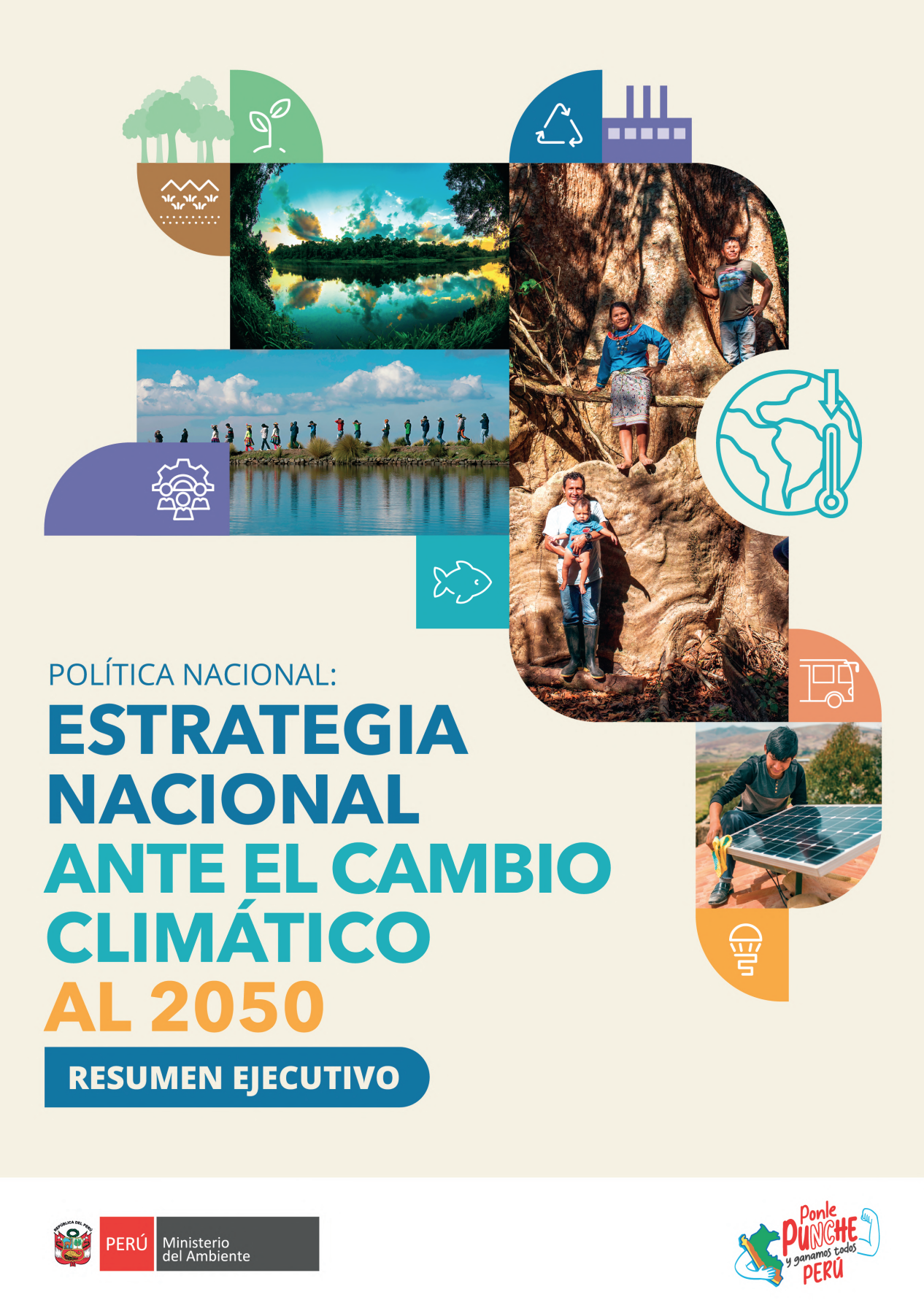
In June 2025, Peru joined 76 other countries that had submitted a Long-Term Strategy (LTS) to the UNFCCC, charting its path to net-zero emissions and climate resilience by 2050. Since then, three more countries have submitted their strategies, bringing the total to 79 LTS as of today.
The strategy—known as the Política Nacional: Estrategia Nacional ante el Cambio Climático al 2050 (ENCC 2050)—is not just another policy document. It is Peru’s collective response to the realities of climate change already shaping lives: shrinking glaciers, shifting rains, rising health risks, and growing pressure on agriculture and water security.
Peru’s Ministry of Environment (MINAM) received technical and financial support from 2050 Pathways Platform, United Nations Development Program (UNDP) and the Inter-American Development Bank (IDB), for the elaboration of ENCC 2050. The last round of support was coordinated through the NDC Partnership’s Global Call for NDC 3.0 & LT-LEDS.
What Makes this LTS Different?
Unlike many strategies that remain isolated from decision-making, Peru’s ENCC is fully integrated into the national planning system (SINAPLAN), ensuring climate objectives are woven into budgets and policies across government. This achievement required dedicated work and innovative approaches to embed a cross-sectoral agenda like climate change into core planning processes. It reflects a shift from treating climate policy as an add-on to making it a structural component of national development, a transformation that demands persistence, coordination, and time.
It also shifts the narrative by framing climate action as a development priority. The ENCC is not only about reducing emissions; it is about safeguarding jobs, improving health, securing water, and protecting prosperity. By centring climate within development planning, Peru signals that resilience and wellbeing are the foundation of its long-term vision, and climate action is the means to achieve it.
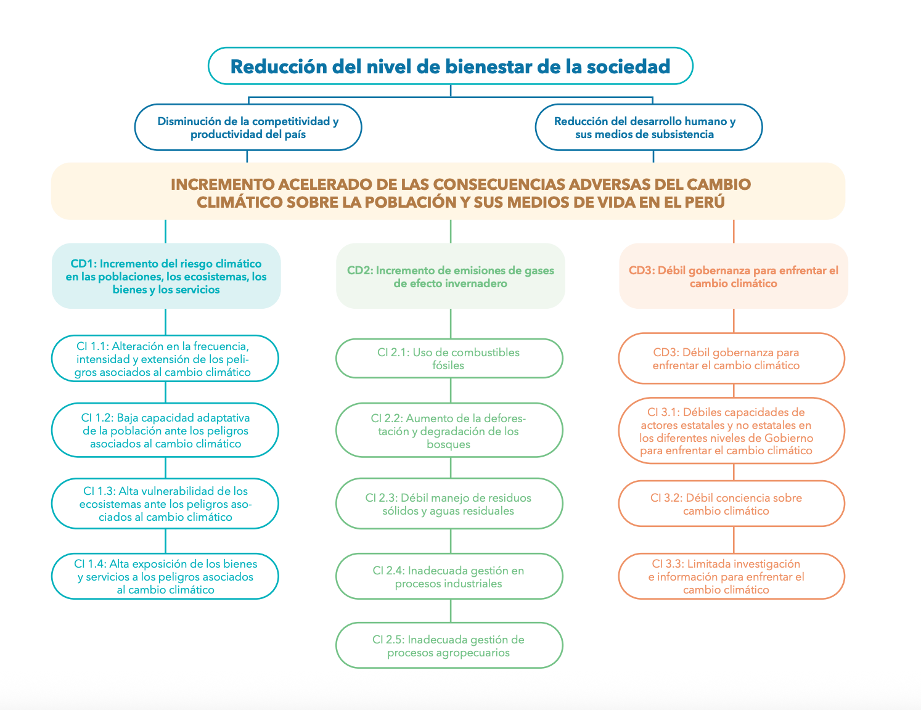
The graph below, taken from Peru’s ENCC 2050, tells a clear story. It shows how climate change is eroding Peru’s quality of life by weakening competitiveness, reducing productivity, and limiting human development and livelihoods.
The ENCC identifies three main drivers behind this trend — rising vulnerability, growing greenhouse gas emissions, and weak governance. Each is unpacked to show how climate risks and responses connect across key sectors of the economy. Together, they highlight an urgent truth: tackling climate change isn’t just about the environment — it’s about safeguarding Peru’s long-term prosperity and the well-being of its people.
Another defining feature is the highly participative approach to the strategy’s development. Through the participatory process Dialoguemos, Indigenous organizations, youth, women’s groups, civil society, businesses, and local authorities all contributed their ideas. Their concerns—from highland communities facing shifting rains to urban groups worried about health risks—were translated into concrete measures for both adaptation and mitigation.
Goals and Commitments
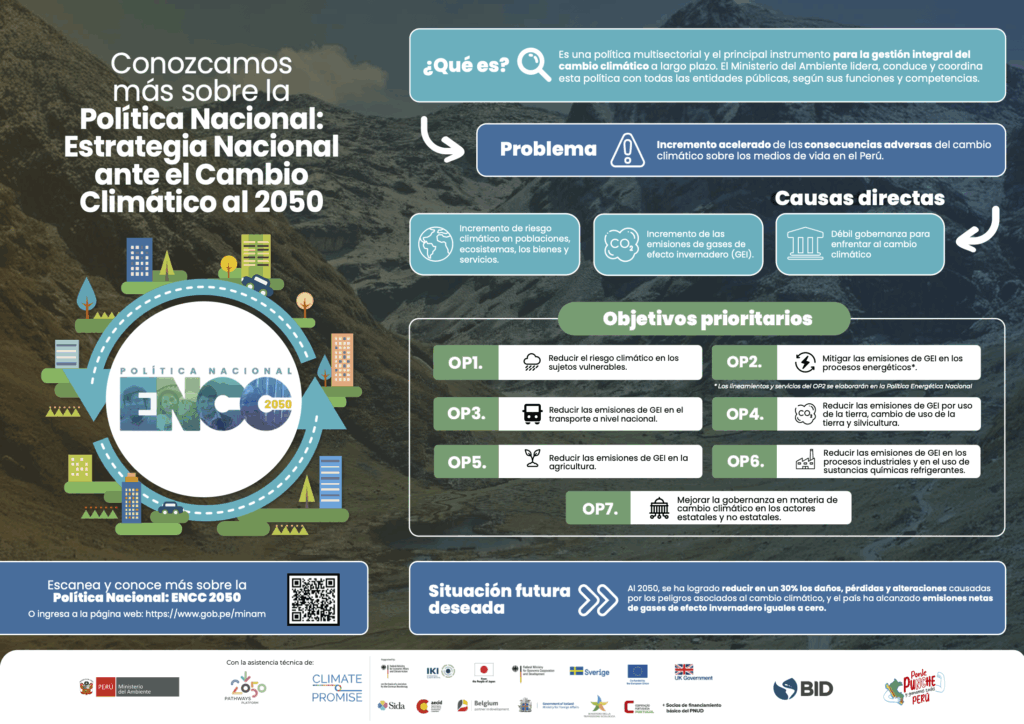
ENCC 2050 sets out seven national objectives, 18 guidelines, and 64 public services across adaptation, mitigation, and governance. By 2030, Peru aims to reduce climate-related damages by 20 percent and peak emissions at 179 MtCO₂e. By 2050, it seeks to cut damages by 30 percent and achieve net-zero emissions through renewable energy, zero-emission transport, circular economy practices, halting deforestation, and stronger protection for vulnerable communities.
This long-term ambition is backed by a clear economic case. A cost-benefit analysis supported by the IDB and the 2050 Pathways Platform found that reaching carbon neutrality could deliver around USD 140 billion in net financial benefits for Peru. Much of this comes from cleaner energy, better health, and avoided damages, with electrified public transport alone offering more than USD 90 billion in savings. Climate action, the analysis shows, is not a burden but a major opportunity for Peru’s competitiveness and prosperity.
For investors and development partners, this provides a clear signal: Peru has a robust and nationally owned framework to drive climate action and leverage international support for investments in resilience and decarbonization.
The Road Ahead
The real challenge now is to turn the vision of ENCC 2050 into concrete actions. This will require a coordinated effort to ensure the full integration of ENCC 2050 objectives into sectoral planning instruments, strengthen intersectoral coordination, and promote alignment with Peru’s NDC 3.0, so that international commitments are reflected in national programming and contribute to the 2050 carbon neutrality goal. To do so, it will be essential to strengthen national institutional capacity and facilitate the mobilization of critical public and private resources to sustain mitigation and adaptation measures.
Peru’s ENCC 2050 demonstrates that long-term strategies can be more than an effort to comply with the Paris Agreement. When embedded in development planning and built around wellbeing, they become blueprints for resilience, prosperity, and social transformation.
Contributing Authors:
- Jimena Paola Mora Cárcamo, Ministry of Environment (MINAM), Peru
- Miguel Junior Figueroa Requena, Ministry of Environment (MINAM), Peru
- Rosa María Pineda Yupanqui, Ministry of Environment (MINAM), Peru
- Sofia Azucena Huangal Alvarez, Ministry of Environment (MINAM), Peru
- Marcela Jaramillo, 2050 Pathways Platform
- Viktoria Dimitrova, 2050 Pathways Platform
Sorry, the comment form is closed at this time.